One of the attractions of Dominican Republic are the beaches, so here I marked the ones that are most visited. I particularly love the beach. Every time I could, I went there to enjoy the sea, the sand and the sun!
A- Juan Dolio, San Pedro de Macoris, DR
B- Bayahibe, La Altagracia, DR
C- Punta Cana, La Altagracia, DR
D- Las Terrenas, Samana, DR
E- Cabarete, Puerto Plata, DR
F- Sosua, Puerto Plata, DR
View Larger Map
martes, 11 de febrero de 2014

Reflection (week 6) - Embedding Media & Psychological Foundations (II)
This time I want to share a video which captivated me since the moment I watched it for the first time! It was made by a tourist who went to Dominican Rep. with his brothers and his best friend, and started a journey to discover the "hidden and unhidden beauties of the tropical Caribbean island".
I cannot be more proud to belong to that magnificent piece of paradise!
I cannot be more proud to belong to that magnificent piece of paradise!
lunes, 10 de febrero de 2014
Reflection (week 6) - Embedding Media & Psychological Foundations (I)

This time, the idea
is to illustrate how to pursue the integration of visual and interactive images
and media into classroom. We have many ideas of how to improve the learning
experience so, it's time to work!
Keeping the storytelling in mind, here I show you some pictures of my beautiful Dominican Republic!
1. Segafredo Ristorante, Zona Colonial, Sto Dgo, DR.

This is one of my favorite places to visit back home, because it's at the beginning of the colonial zone of the city. It's very stylish and suitable to share a bottle of wine with some friends.
2. Altos de Chavon, La Romana, DR.
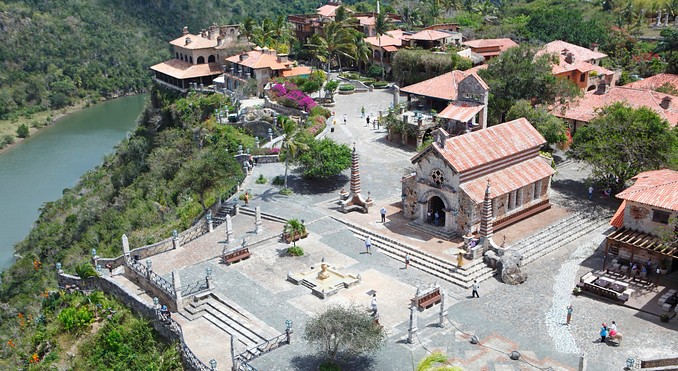
The biggest attraction in La Romana, Dominican Republic, is Altos de Chavón, a re-creation of a medieval European village conceived from the imagination of Roberto Copa, a former Paramount Pictures set designer, and Charles Bluhdorn. The landscapes, the view of Chavon river and whole village is exquisite.
3. Monument to the Heroes of the Restoration, Santiago, DR.

On a hill overlooking Santiago is a high marble monument. Construction of the monument began in 1944 on the orders of then-dictator Rafael Trujillo. He named it the "Trujillo's Monument to Peace", and was designed by architect Henry Gazón Bona. Trujillo was assassinated in 1961, after which the monument was renamed the "Monument to the Heroes of the Restoration", in remembrance of the Independence Restoration War of 1863, in which the Dominican Republic regained its independence from Spain.
These are just a brief examples of how rich my country is and also, how many places still there waiting to be discovered!
jueves, 6 de febrero de 2014
Reflection (week 5) - Instructional Design and Technology in Classroom
In
classrooms has been implementing the use of technology as a way of support the
work of teaching. The example describes that have been provided to teachers and
students laptops with internet, using these tools at all times.
However,
the use of these resources has many advantages for learning and also many other
disadvantages. Therefore, the teacher should make use of applications that allow
him to measure the performance of their students, such as virtual classrooms,
work group collaboration and online quizzes. Because what cannot be measured,
cannot be improved.
An example of a
classroom project could be a photo sharing (keeping as a storytelling project
as well), so teachers can incentive his students to use any
application to create this assignment and share experiences in class. Speaking
about that, I decided a long time ago to create a user in Instagram, because
through this application I can share my points of view, what impacts me and
what I like. Also, I can follow another users, create and follow hashtags and trend
topics. So, click and look my Instagram!
Finally, the use of
technology in the classroom is a challenge, since the cooperation of all is
needed to achieve positive, long-term and quality results.
jueves, 30 de enero de 2014
Reflection (week 4) - Social bookmarking & defining our field
Social bookmarking & defining our field.
Social bookmarks allow teachers to locate, store, tag and annotate online resources to access them from any computer and share them with the educational community. That's why DELICIOUS becomes an innovative tool that can be used in teaching because it allows us to create a library on the subjects of our interest, enables us to access the library from other users, share and collaborate on posts selection of topics of interest, which is an added value to the daily work of the teacher and his updating thru his work.
It is an online activity in which users can store and categorize favorite links that can be shared with others. Even users can add other favorite to their collection and subscribe to other users' lists. The contents of the linked files are organized into what are known as "tags".
Among the advantages of DELICIOUS, I appreciated its use as a resource for students and teachers to continue developing a list of links in a class, as it is a tool in which students can include links related to their research project. Therefore this technology helps to improve learning and here is my DELICIOUS webpage.
In the development process of every day, I can say can be noticed a requirement of the use of information technologies because new generations are more identified through these media, so social bookmarking is an excellent alternative as they are consistent with the reality of the times and are also easy to use. The communication can be maintained between the employee and the employer, as these technologies enable the creation of discussion forums, feedback and new ideas (Reiser & Dempsey, 2012). In addition, through these tools, chats can be conducted, video conferencing is possible, also virtual training and continuous feedback, so by an effective communication can be built an integrated working environment, leading to good results in favor of the achievements of the institution.
References:
Reiser, R.A., & Dempsey, J.V. (Eds.) (2012). Trends and Issues in Instructional Design and Technology (3rd ed.). Saddle River, NJ: Pearson Education.
jueves, 23 de enero de 2014
Reflection (week 3) - WEB 2.0
THE WEB 2.0
Web 2.0 is the transition that has occurred from traditional to
applications that work through the web focused on the final user. These are
applications that generate collaboration and services that are to eventually will
replace desktop applications.
Although many people still use this term as a marketing fashionable word
and other senseless even accept it as a new form or line of communication and
exchange of knowledge, we must also consider that the real impact of the web
2.0 will be significant as soon as we use the new tools to create innovative solutions to
make life easier for all users.
What is called Web 2.0 refers to a set of applications that have emerged
in recent years on the Web that have made it much easier for anyone to be both
generator and/or consumer of web content. This is because these applications
are normally free and very easy to use, allowing us all to be able to publish
web content with just having several network access formats. In short, the
Internet has grown from a reading to be read-write.
I can say that lately, in print media and on the Internet is increasing
talk of weblogs, games, videos and photos shared with family or friends sharing;
news spread through podcasting; is co-published in a participatory manner
encyclopedias online; are consulted or published classified ads; texts or tags
to photos, music, etc. are added, which are posted on the web, so that others
can look at websites; users subscribe to the content authors, allowed by RSS by
sites that communicate automatically updates to their subscribers; word
processors which use Internet as a platform and many more. I explain more in my Wiki page.
In short, Web 2.0 allows anyone to be an author and user of content in
various formats, which in turn can establish networks and spaces of social
interaction in a natural way, and finally manage, retrieve, share information
and interact very easily through the same Web.
jueves, 16 de enero de 2014
Reflection (week 2) - Dale's "Cone of Experience" and Siegel's concept of "Computer Imagination"
REFLECTION
Week 2
The experience using Blogs and RSS
Readers has being really interesting. I’m kind of familiarized using Blogs and I
particularly think this resource is very useful to transmit ideas and share
information. I haven’t used the RSS Reader before and for me, using this tool
is pretty new but easy-going. These resources, Blogs and RSS Readers, are very
useful when expanding the horizons concerning where to get the information in a
quickly and updated way.
After reading Dale’s “Cone of
Experience”, I believe Blogs and RSS Readers could be placed at “Contrived
Experiences” stage of the cone by themselves, because they're just resources
and the trick is that the individual needs to know how to use them. When
teachers give the concepts, ideas and exercises the students need to have prior
the use of this kind of technology, each one of the learners would be able to
know what tool to choose, how and when to use it and “the Cone may help (us) to
choose the instructional materials that are most appropriate for the particular
topic (we wish to teach)” (p. 132). Learners will be able to experience the
resource in a direct way, giving meaning to their work and increasing the
richness of their learning experience.
Eventually, as students become
familiar and develop their knowledge in the use of Blogs and RSS Readers to
spread and contribute with their learning process, these tools could be placed in
the phase of “Direct Purposeful Experience” resources, because the students
makes an interaction with the world around him and makes a connection through
other media with other students, trading information and experiences.
About Siegel’s “Falling Asleep at
Your Keyboard” I can say about the concept of “computer imagination” that an “imaginative”
educational use of the Blog could be to post an interesting article of a useful
topic for the class, so the students could have access and the next day have a
discussion about that information in the classroom and exchange ideas about it.
Also, by RSS Readers, the students can post comments directly to the teacher’s
Blog’s article and also have an updated feedback of what each classmate think
and reply the comments. These uses are the ideal of what should be a 21st
Century classroom (p. 2).
For
example, blogs are a tremendous help to give continuity to a lesson outside the
classroom, as students have access to the internet and through this source, can
access information posted by the professor. Also, to have updated information
about a topic that is being studied in class, RSS Readers are very useful
because we can have quick access to information. At the end, these resources
help education in distance.
Finally,
I think at the time that the classroom becomes a place where teachers and
students converge in an interactive space, aiming at improving the
communication between them and developing new techniques that allow growth in
the use of technology they have available, education will be greatly benefited
by the use of these resources.
Suscribirse a:
Entradas (Atom)